Showing posts with label scones. Show all posts

Thursday, 31 October 2013

Treacle Scones


Several years after my grandmother died, I was given her cookery books. They were kept in the darkest corner of her kitchen and stacked, piled and slotted together to fill every shelf.

Amongst them I found a slight yellow and brown volume from the 70’s named Devonshire Flavour, compiled from various local contributors. In it, I found my first reference to treacle scones. A. N. Winckworth from Dunchideock House provides the recipe, explaining that the scones should be made with genuine Dunchideock treacle, “mined from the local theriaciferous rocks”. Without pausing to think, I swallowed the story whole.


After pointing out that other treacle can be used, the editor drily notes: “It is perhaps due to Lewis Carroll’s reference to a treacle well that supplies have become so elusive; becoming... almost exhausted”. At the Mad Hatter’s tea party in Alice’s Adventures in Wonderland, the sleepy dormouse tells a story about Elsie, Lacie and Tillie, the three little girls who lived in a “treacle-well”. Alice is incredulous: “There’s no such thing!”

Treacle wells and mines seem to have become a joke to trick the gullible around the time of Carroll’s writing. They still pop up – they’re mentioned in Terry Pratchett’s novels and there are plenty of websites about treacle mines.

Treacle is, of course, the syrupy product of refining sugar - sadly there are no wells or mines involved.


The treacle well in Alice was inspired by St Margaret’s Well, next to the church in Binsey, Oxfordshire. It can still be seen today, sunken and encased in mossy stone. The well was called a treacle well because the Middle English word triacle meant a curative antidote or medicine and the water was believed to have healing powers. It has been a place of pilgrimage for centuries - Henry VIII and Catherine of Aragon are said to have visited to pray for a healthy son. Carroll twists this around, causing the three little girls in the well to become “very ill” from consuming the treacle.


The story behind the healing powers of the well goes back to the eighth century. According to one version, a local noblewoman called Frideswide ran to Binsey trying to escape the advances of King Algar of Mercia. Algar caught Frideswide but when he touched the holy virgin’s hand, he was struck blind by heavenly powers. In pity, she prayed that his sight might be restored. In answer, St Margaret of Antioch (who has a wonderful story herself – I love her Old English and Katherine Group lives) appeared along with her dragon and told Frideswide to strike the ground with a staff. As it hit the ground, water started to gush out. Frideswide bathed Algar’s eyes and he was healed.

Frideswide became the first Abbess of the Oxford monastery and remained there until her death in around 727. She is the patron saint of Oxford. Her tale has been handed down the generations in several versions (some not quite as dramatic as the one above) and several formats (you can see her story depicted in a big stained glass window in Christ Church Cathedral). Chaucer even has the Oxford-based carpenter cry "help us Saint Frideswyde" in the Miller's Tale.


Treacle scones are homely, richly flavoured and particularly good with salted butter, hot from the oven. I wasn’t expecting to like them quite as much as I do.

I imagine my granny would frown at the extravagance of splashing the unbaked scones with melted butter and covering them with a crunchy coating of Demerara sugar, but it tastes too good to stop.


Treacle Scones

230g plain flour*
30g dark brown sugar
2 tsp baking powder
1 tsp ground cinnamon
pinch of salt
120ml milk
2 tbsp black treacle
60g cold unsalted butter
5 tsp Demerara sugar

Preheat the oven to 200C/390F. Line a baking tray with baking parchment. Sieve the flour, sugar, baking powder, cinnamon and salt together – you may have to squish the sugar through with a spoon if it’s a fine sieve. Stir everything together.

Place the milk and treacle together in a bowl. Using a fork, keep whisking the treacle into the milk until it’s dark brown and the treacle has dissolved. Take 15g of the butter and melt it in a small pan. Cut the other 45g into cubes and then rub it into the flours until there are no big lumps left. Add the treacle-milk and gently combine (I use a folding motion) with a blunt knife or spatula until the mixture comes together – it is quite sticky.

Brush a circle of melted butter about 18cm in diameter onto the paper, then sprinkle with 2 tsp of the Demerara sugar. Tip the dough out onto the sugared paper then pat into a circle about 2-3cm high with flour-dusted hands. Cut into quarters then again into 8 triangles with a sharp knife dusted with flour. Don’t move the scones about – leave them next to each other (don’t worry, they’ll still cook properly when stuck together). Brush with the remaining butter (don’t worry about the butter pooling in the cuts, that’s normal) and sprinkle the remaining 3 tsp of sugar over the top.

Bake for 16-18 minutes until puffy and browning around the edges. Remove immediately to a wire rack so the bottom stays crisp then tear each scone off and eat while still warm with salted butter.

*I've also tried it with 180g plain flour and 50g wholemeal flour, which was lovely.

(Makes 8)


Three more recipes that involve treacle:
2013: Treacle Flapjacks
2012: Gingerbread
2011: Ginger Root Bundt Cake

Monday, 8 August 2011

Plain Scones


I was born and bred in Devon, England. I am obsessed with the world of pastry and desserts. These two facts combine, as you can probably imagine, into a girl with quite a few opinions and stories about scones and cream teas.

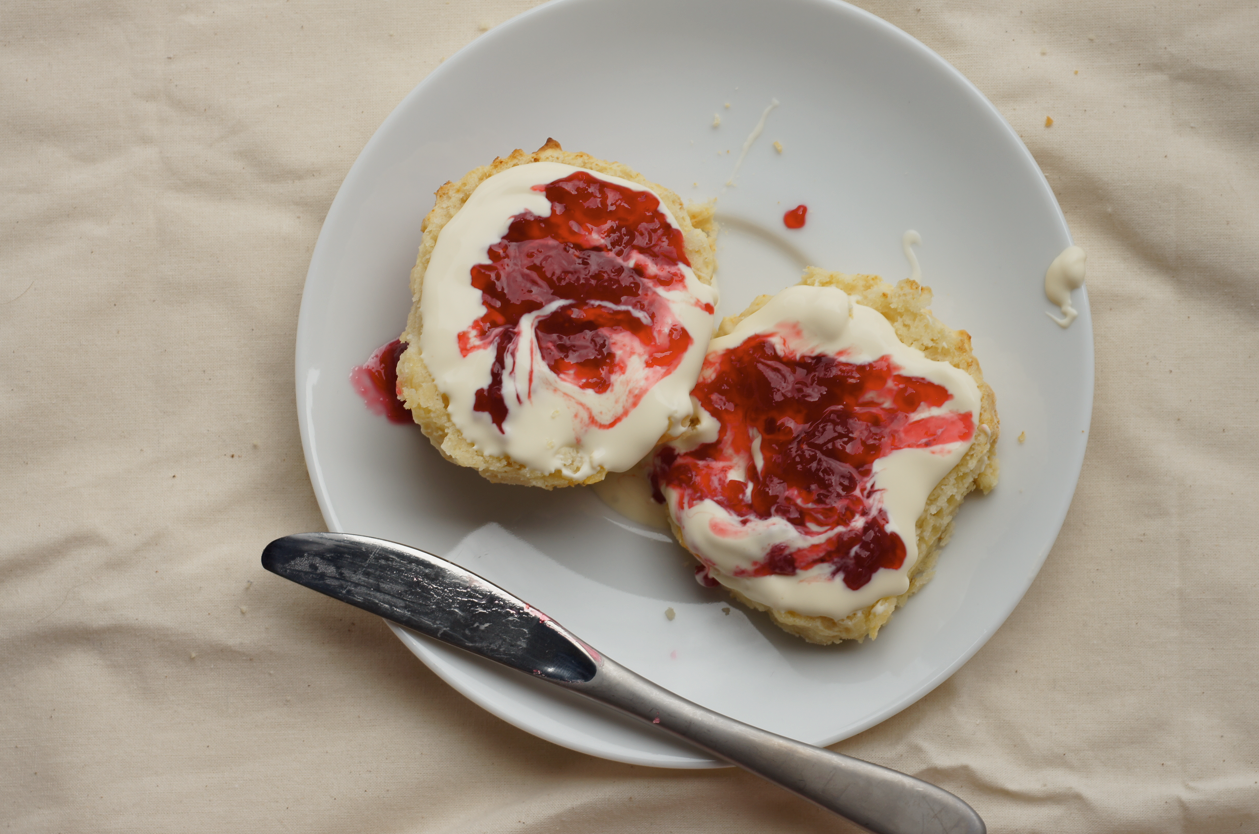
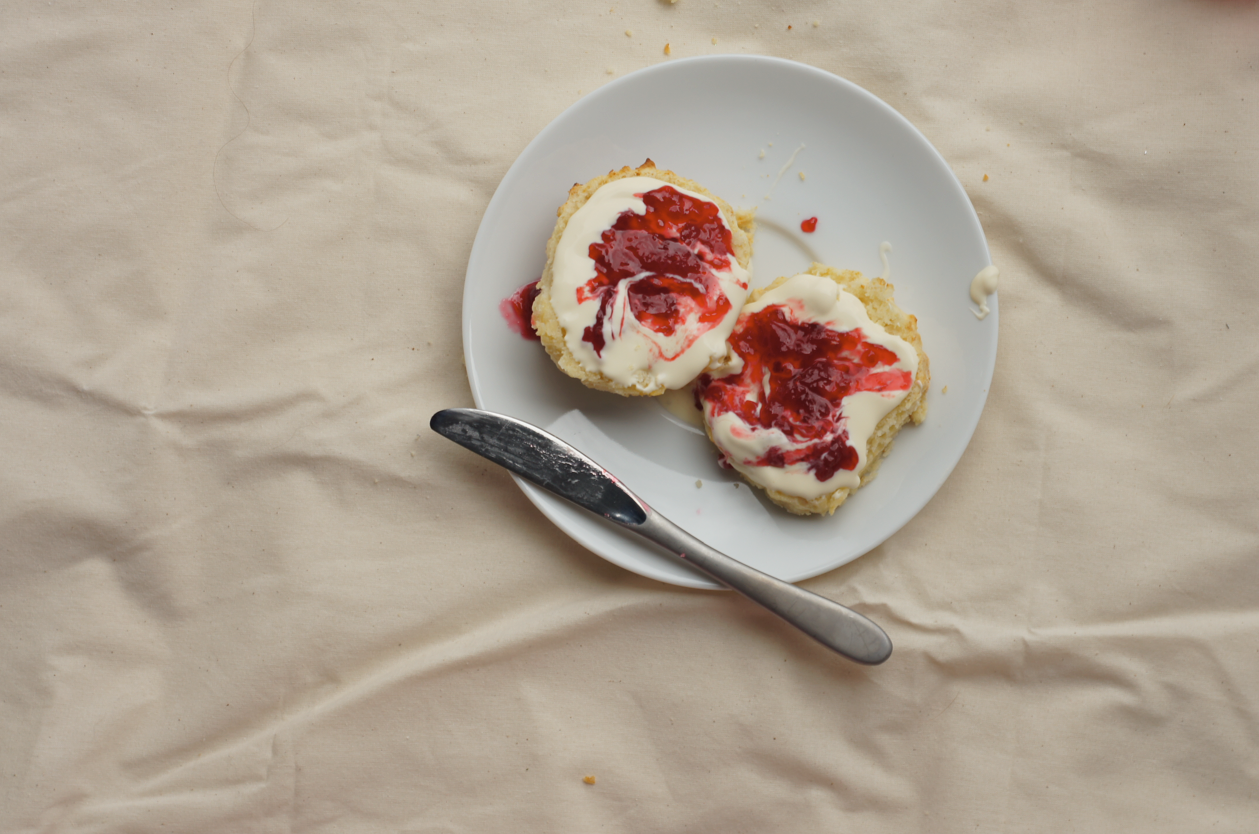
To start at the most obvious point of contention: cream before jam or jam before cream. If you are versed in the ways of cream teas, you might have already guessed my affiliation from my birthplace. I believe in scone-cream-jam.

Though, I have to admit, I don't entirely know why. It's a bit like Cambridge as an Oxford student - you can't quite figure out why you're not supposed to like them, but you find yourself part of the rivalry anyway. And so I prefer the Devon cream tea. I just do.

I have to point out that I do still enjoy a cream tea that doesn't fit everything I say below. I'm also not so opposed to jam-cream to judge people for their preferences. Except my mum, who goes scone-butter-jam-cream, which is just weird.


Given all this love for scones and cream teas, you might think I have been crafting this recipe since I was a toddler, or that it's a family recipe. We have been making scones all my life, but this is the first time I've had the obsession to get a good recipe with them. I made scones five days in a row for tea (yes, we do have afternoon tea every single day at our house. It's a meal just like lunch. When else do you think we eat all these baked goods?!), had a little breather for a day, then finally made them again yesterday.

A timetable:
Day One: Nigella's Lily's Scones, straight up.
Day Two: Lily's Scones plus creme fraiche.
Day Three: raspberri cupcakes' CWA Scones, straight up.
Day Four: Day Three plus creme fraiche and formed into a taller block.
Day Five: Day Four plus a different method of combining ingredients.
Day Six: a glass of water and a carrot stick. 
Day Seven: Day Five plus a higher temperature.

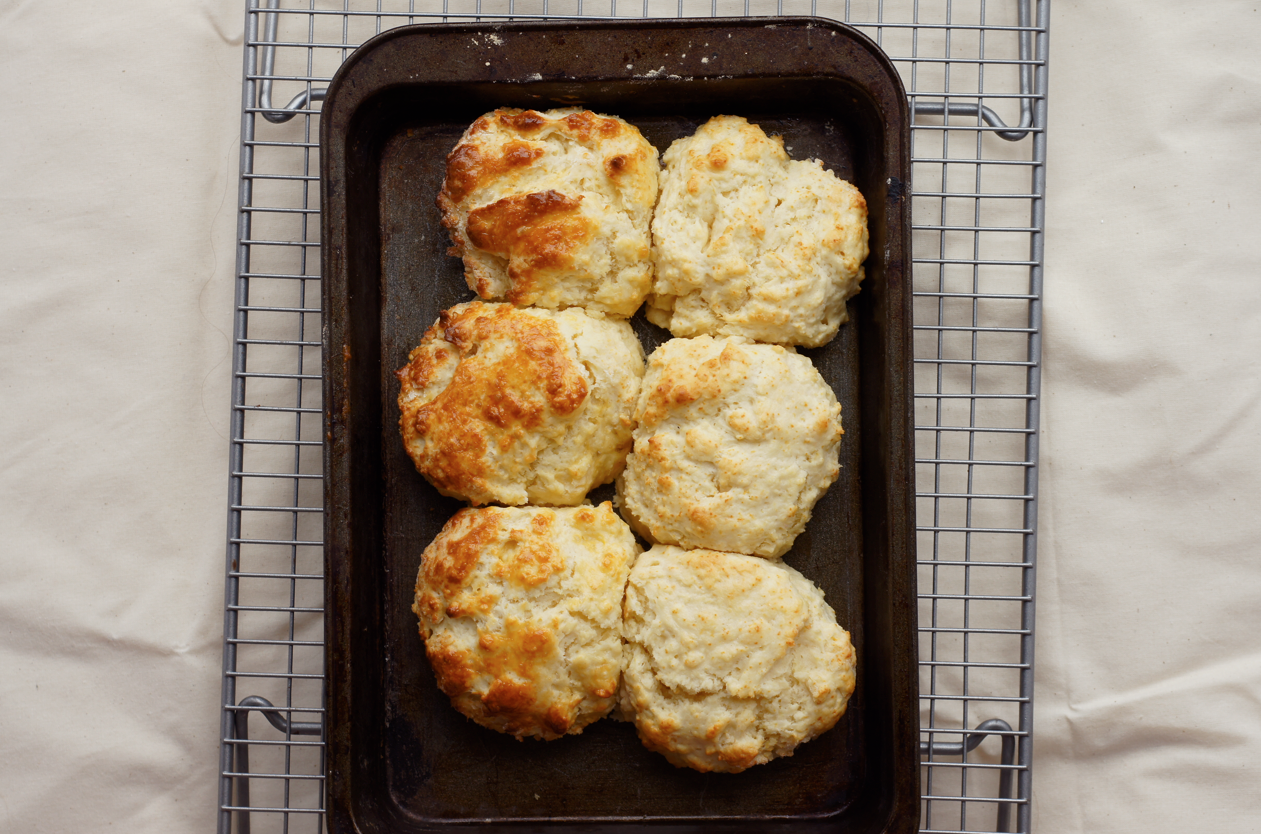
A good scone should be lightly browned with a crispy crust and a light, fluffy interior. I like using the creme fraiche because it gives the scones a little tang. Not having butter in the recipe makes it faster and easier too. You can either wash these with milk or egg depending on how brown you'd like them. You can see this on the batch above, where the ones on the left are egg washed and the others are milk washed.


In Oxford, I ate a lot of cream teas. I never found the perfect one. The Vault off Radcliffe Square came closest. The Old Parsonage came next. The main problem with most cream teas is that they focus on the scone or even the tea and forget the rest (though you do get awful scones too).

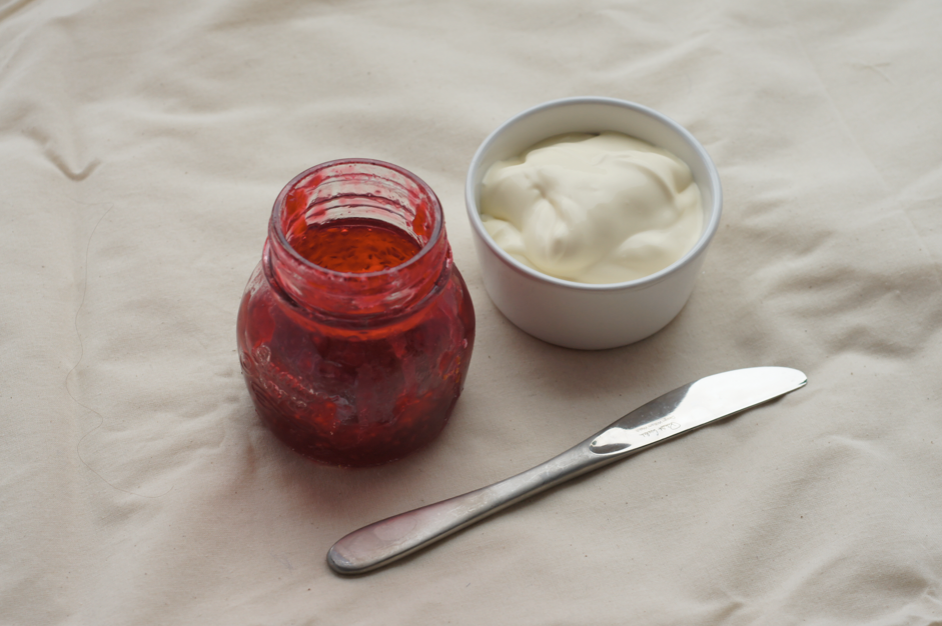
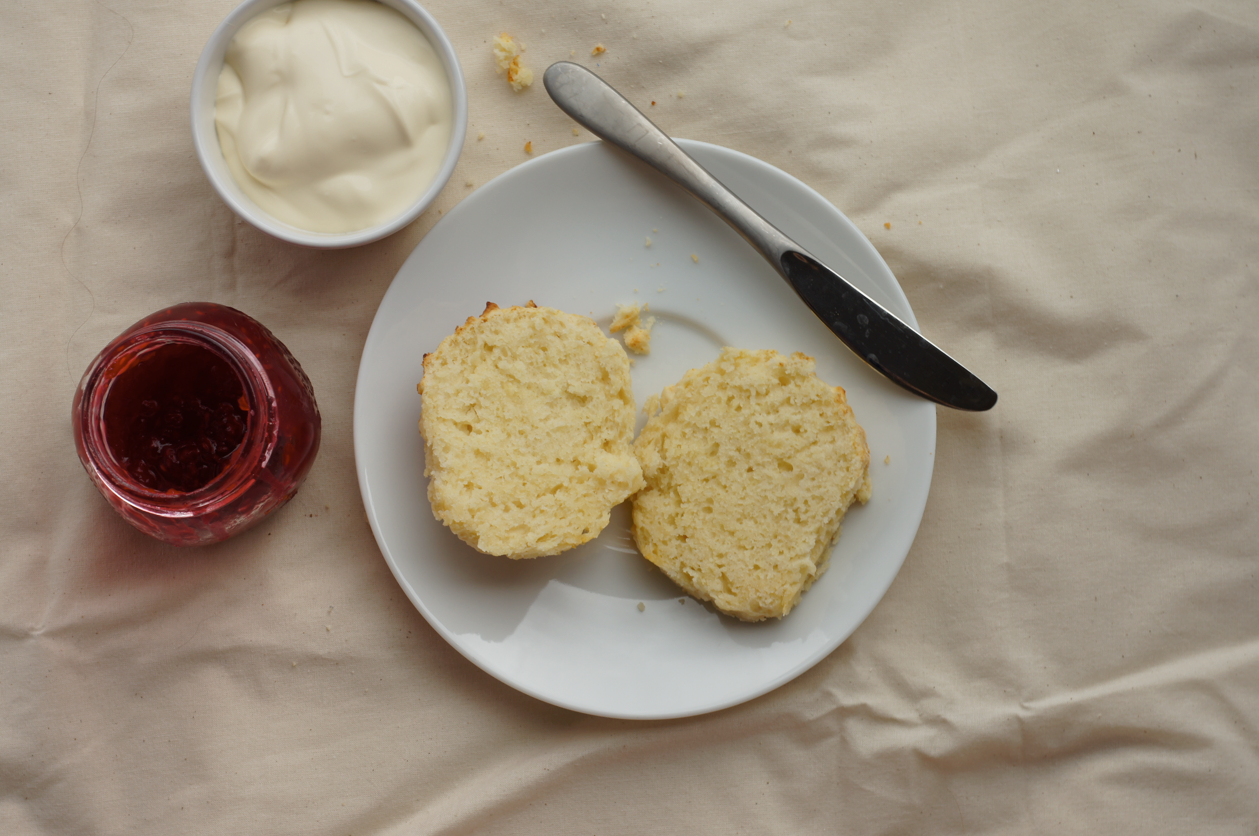
The quality of the cream and jam is paramount, as is the quantity. A thimble of mediocre clotted cream  for two scones does not make a good cream tea. You need plenty of good quality clotted cream (not too much crust, and it shouldn't be grainy at all) with some good jam, preferably raspberry or strawberry. Don't be shy with the cream - it's what gives the scone its moisture and luxuriance. I like homemade raspberry jam.

A cream tea isn't particularly sweet: the scones don't have any sugar, the cream should be unadulterated and hopefully the jam won't be too sugary either.


I know a lot of people can't get good quality clotted cream outside of Devon and Cornwall and particularly outside the UK. Mum can't get it here in Switzerland. Recently we tried making it using a method she had used as a child with the unpasturised milk we get from the local laiterie. We tried a couple of times with different methods but it never really worked.

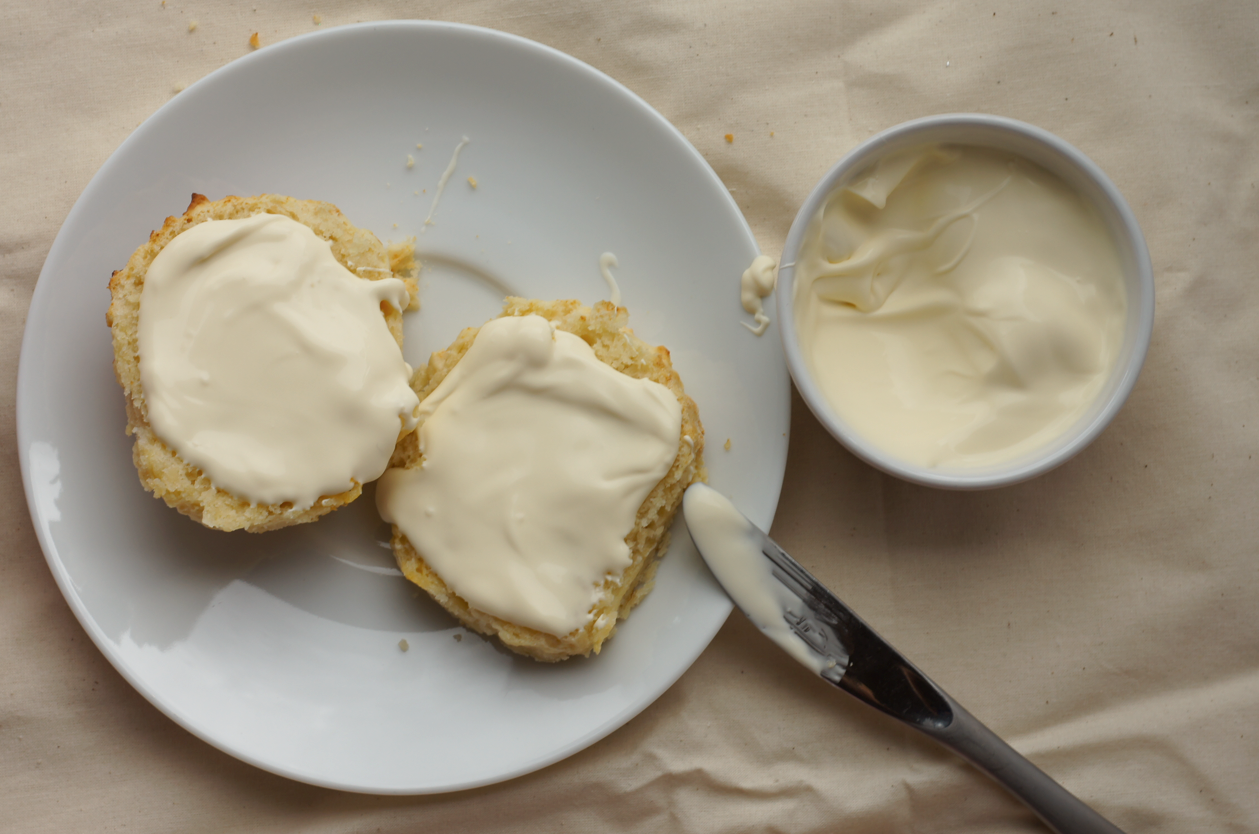
Then about a week ago I was working on a catering job and discovered the cream they were serving with the meringues and summer fruits. It's Gruyere double cream, which we had been buying in the supermarkets for years, but from the Chaumerie in the centre of town. This version is seriously thick. And guess what - it tastes exactly like clotted cream without the crust! BINGO. It's great for scones, though the latest pot we bought wasn't quite as thick as the last, so it looks a tiny bit runny in these photos.

I realise this still doesn't help most of you. I reckon that the best substitute might be marscarpone beaten with a little bit of double cream if you can't find clotted or a super super thick cream.


Finally: tea. A cream tea, as the name suggests, needs a cup of tea. Or a pot. Though any English breakfast type tea will do, I am an Earl Grey girl. So I would always pick that. If I have the choice, I will drink my ultimate favourite tea that I love so much I bring boxes and boxes out to Switzerland and jumped for joy when they extended it from a limited edition to a regular feature: Twinings Blossom Earl Grey, with orange blossoms and citrus bergamont. (I'm in no way sponsored to say that, I just love tea.)

Also, fun fact: I believe the very first photograph I took of food when I was 13 was of a scone loaded with cream and jam. I tried to find it for you but sadly I think it's in England.

To me, a good cream tea is one of life's ultimate pleasures. It's all about the slight crisp from the crust, the fluffy scone with a sour note, the cool, thickly luxurious cream and the contrasting bright tones of the raspberry jam. Perfection.


Plain Scones
(adapted from raspberri cupcakes' version of CWA scones)

230g plain flour
2 teaspoons baking powder
1/4 teaspoon salt
135ml double cream
1 tbsp (15ml) creme fraiche
100ml whole milk
an egg yolk, or a little extra milk, to glaze

Preheat the oven to 230C. Lightly grease a small baking tray. Sieve the flour, baking powder and salt into a medium mixing bowl. Place the double cream and creme fraiche into a small bowl and whisk together.

Pour the cream mixture into the flour bowl and fold in very gently with a metal spoon, being careful not to overwork. When it is incorporated, add the milk in three portions, carefully folding between each. You don't need the dough to be uniform - just a sticky mess.

Dust your work surface with flour then tip the dough out onto it. Dust your hands with flour then quickly and lightly form the dough into a square about 3-4cm tall. Press down on a floured 6cm fluted biscuit cutter to stamp a scone out of the dough. Place onto the greased tray. You should get four scones out of the original square - place them close to each other on the tray, almost touching. Roll the remaining scraps of dough into two circles gently and with floured hands press lightly into the cutter (I find this causes less overworking than re-rolling). Place onto the tray.

Brush the tops of the scones with a pastry brush with either a little extra milk or an egg yolk. Place into the oven and bake for 13-15 minutes until risen and golden. Serve while still warm.

(Makes 6)

ShareThis