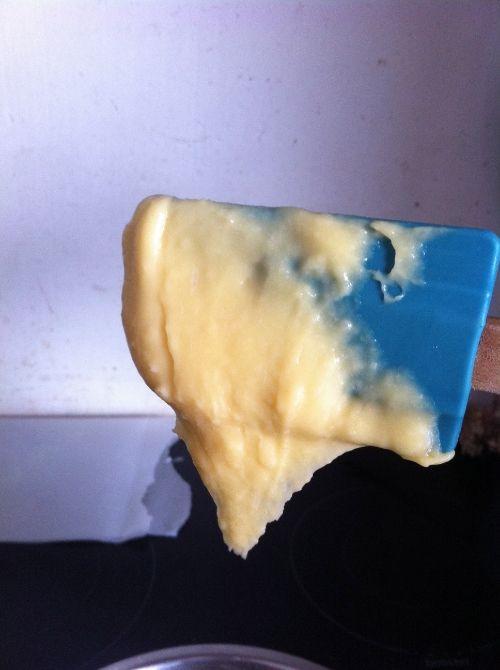
I like white chocolate but I wouldn't normally choose to eat it. But if you roast it until it caramelises and add a touch of salt? I can't leave it alone.
Though I have a faint memory of reading David Lebovitz's post about caramelised white chocolate in 2009, I didn't try making it until the day Food 52 published an article about it. It felt like the first time I tried brown butter - a whole new set of possibilites opened up and I couldn't stop thinking about it.

I have to admit that I still haven't tried it with the original Valrhona Ivoire. I didn't get around to ordering any before I left England last week and I haven't been able to get my hands on any here in Switzerland.
However, I have had great success with Green & Black's White (twice) and Lindt Blanc. I've also tried a bar of Cailler Blanc Vanille but it quickly seized. I tried combining it with a bit of oil and blending it (as advised on Food 52) but it was still gritty and tasted oily. After buying some Felchlin couverture from a local bakery, I was very surprised when it seized instead of melting. Instead of trying to blend it, I left it in the oven until it reached a similar caramel colour. The tiny nuggets of chocolate tasted just as good and I think if you melted them down with a touch of cream, they might liquify.

After a few spoonfuls of the caramelised chocolate, I decided that I needed to make éclairs.
Choux pastry and I have history. Three years ago, after I started building croquembouche shaped like presents with chocolate ribbons, I became obsessed with choux pastry. I spent hours filling out spreadsheets with dozens of recipes, comparing ratios, temperatures and methods.
Then it turned up at Le Cordon Bleu. Éclairs were one of our three exam dishes in my first term. Though I'd been warned about having a favourite, I thought that I had a much better chance of a good mark with one of them. I was convinced that I would pick the right slip out of the bowl of folded papers as I stepped into the exam room. But I didn't - I picked the éclairs.

My focus blurred and for the first time in my life, I didn't rise to an exam. I tried to reason with myself that it couldn't possibly be harder than finals but once it had started to get messy and out of sync, I couldn't claw it back. Looking around, I compared my work to my classmates even though I knew it wouldn't help. Somehow I managed to cut myself on a plastic d-scraper and had to go out to patch it up. Struggling to breathe, I moved around in slow motion, time running out despite every minute feeling like an eternity. I screwed up the elements I was best at and left the room feeling sick.
The feeling lingered on, even though I passed and my other marks pulled me up to a good grade overall. I was embarrassed that I had let it get to me, that I'd cracked instead of rising to the occasion. To be honest, I still am.
The experience coupled with the type of éclairs we made (filled with cloying coffee pastry cream, topped with super-sweet fondant) clouded my love of choux pastry. I stopped making it, even though fresh éclairs filled with softly whipped cream and topped with melted chocolate are one of life's great pleasures.

In general, my experience at Cordon Bleu pushed me away from neat pâtisserie towards the simple, the not-so-sweet, the seasonal and the slightly messy. I like the odd drip of golden chocolate sneaking down the side, streaking the escaping cream.
I can't think of a better way to use the caramelised white chocolate and - while I worry about hyperbole - they're one of the tastiest things I've ever made.
Though the general consensus seems to be that you should make the chocolate in big batches of 350 - 450g, I like smaller batches so I can try different things out. The recipe below makes just enough to cover the six éclairs with a bit extra for tasting - you could easily make more and use it for other things. When I was taking these photos, I was making a double batch of the choux, so the amounts you see are a bit bigger than you'll get from the recipe below. I weigh the liquids for the pastry as they're small amounts and need to be accurate.
If you don't often use a piping bag or want some tips, I recommend this excellent tutorial on BraveTart. I use disposable bags like these.
Finally, I really recommend tasting and smelling the chocolate as it roasts and sensing how it develops each time you take it out. The colour is a good guide but it's far more fun to eat it. Do try it before and after the salt, too - the difference is quite spectacular.

Caramelised White Chocolate Éclairs
(chocolate adapted from Valrhona via Food 52)
For the caramelised white chocolate:
100g white chocolate (30%+ cocoa butter)
pinch of fine sea salt (I use fleur de sel)
For the choux pastry:
25g butter
35g water
25g whole milk
pinch of salt
30g plain flour
1 large egg
For the whipped cream:
150g double cream
1/4 tsp vanilla paste (or extract)
Preheat the oven to 120C/250F for the chocolate. Break up the chocolate and place it in a small baking tray. Put into the oven. After five minutes, take it out and stir with a spatula - it may be stiff at first but should smooth out. Repeat every five minutes until it is a lovely deep caramel brown (mine took about 40-50 minutes*). Stir in the salt. Scrape into a small bowl or jar and leave to cool. This should keep for months - it will cloud once it cools but don't worry.
Preheat the oven to 200C/390F for the choux. Prepare a piping bag with a plain tip (not sure of the number but mine has a diameter of 1.3cm), push the bag into the tip and sit upright in a tall glass. Grease a baking tray. Cut the butter into cubes and add it to a small saucepan (mine is 15cm) with the water, milk and salt. Sieve the flour onto a big sheet of baking parchment, fold in two to make a shoot and put near the hob.
Put the saucepan over a low heat until the butter melts. Turn up to medium-high and bring just to the boil - when it's steaming and you see the first bubbles in the middle, take off the heat and immediately shoot the flour in off the baking parchment and stir with a wooden spoon until it comes together. Put back onto the heat and stir for 1-2 minutes - you should have a stiff ball of paste that sizzles and leaves the sides of the pan clean. Tip into a mixing bowl and squish up the sides to help it cool.
Leave to cool for a few minutes until it's warm - not hot - to the touch. While it cools, beat the egg lightly together. Add a dribble of egg to the bowl and beat into the paste (it goes slimy and looks like it won't incorporate but if you keep going it will). Keep adding small amounts of egg until it is all incorporated - around 6 inclusions. If you scoop up the mixture and turn the spoon to the side it should hesitate, then fall off in thick ribbons, leaving a hanging tail. Scrape into the piping bag and seal. Pipe 11-12cm lines onto the tray, flicking back onto the éclair to finish, leaving a few cm in between. There should be enough for 7, which gives you one spare in case of accident (or for a few profiteroles...). Add a dash of milk to the eggy bowl, then dip a pastry brush into it and lightly brush in opposite direction to your piping, smoothing down the flick.
Bake for 20 minutes at 200C without opening the door, then turn down to 180C, use a wooden spoon to jar the oven door open and bake for 10 minutes. They should be deep golden brown all over and crispy. Cool on a wire rack. (You can store them for a day in a sealed tin, but they're best fresh).
Place the chocolate over a pan of barely simmering water and melt. Leave to cool and thicken slightly. Pour the cream into a mixing bowl and add the vanilla. Whip until you have soft peaks (or whip in a stand mixer but be careful not to overwhip). Slice the éclairs lengthways with a serrated knife. Spoon the whipped cream into the bottom half then place the other half on top. Use a blunt knife/small palette knife to spread the chocolate on top. Serve quickly - they're best within an hour. You can keep leftovers for 24 hours in the fridge, but they're not as good.
(Makes 6 éclairs, can multiply up)
* Several commenters have told me that theirs took longer to caramelise - it seems to depend on the oven and the brand of chocolate. If you get fed up waiting, it seems you can increase the oven temperature a little and it should start to turn. I haven't tried it on a higher temperature myself, however.

A few more posts that involve whipped cream:
Coconut Cream Cake
Brandy Snaps
Hervé's Two Ingredient Chocolate Mousse