Showing posts with label apricot. Show all posts

Thursday, 24 October 2013

Apricot & Coconut Loaf Cake


Now the days have become darker and the rain has started pounding on the windows, I've made myself a nest on the sofa. It started when some friends visited last weekend. When they left, they carefully stacked the duvets and pillows from the night before on the sofa. Instead of moving them, I fell straight into the (very comfortable) trap.

Obviously, aside from duvets and pillows, my nest has a large number of books and a laptop cable sneaking out to the nearest socket. All it needed was cake.


This recipe was initially inspired by a cake that I've had a few times at the Vaults in Oxford - I've been meaning to make a version of it for years. The base is a soft, fluffy coconut cake that doesn't dry out. It's laced with apricot jam, which creates a subtle flavour through the cake and a sticky, slightly caramelised bottom. It's a sweet cake, but not in an overwhelming or unwelcome way.

With a large mug of tea, it perfects my autumnal nest.


Apricot & Coconut Loaf Cake

For the cake:
200g unsalted butter, at room temperature
180g caster sugar
3 eggs
120g plain flour
1 tsp baking powder
pinch of fine sea salt
80g unsweetened desiccated coconut
3 tbsp milk
1 tsp vanilla extract
6 tbsp apricot jam/preserve (I like to use a chunky jam that's not too sweet)

For the glaze:
1.5 tbsp apricot jam
1 tbsp water
about a tsp of desiccated coconut

Preheat the oven to 180C/350F. Line a 9 x 4"(23 x 10cm) loaf tin with greased parchment (or as I used here, greased parchment lined foil). Place the butter and sugar in the bowl of a stand mixer (or a mixing bowl if using an electronic hand whisk) and cream until light and fluffy - this takes at least four or five minutes. Sieve the flour, baking powder and salt together.

Whisk the eggs together. Add the egg in small additions to the creamed mix, making sure you beat in between each addition until the mixture has totally incorporated the egg you've added - add a tablespoon of flour about half way through and again near the end to help prevent curdling. When you've finished the egg, add the rest of the flour mix and the coconut and briefly beat to combine. Add the milk and vanilla and stir briefly again until you have a uniform mixture.

Spread 3 tbsp of the jam over the bottom of the tin. Scoop 2/3 of the cake batter on top and level it. Swirl in the remaining 3 tbsp of jam then top with the rest of the cake mixture and level off again. Bake for 45-55 minutes until deep golden brown and a toothpick/skewer can be removed cleanly from the middle.

Combine the jam and water for the glaze in a small saucepan and heat until you have a syrup. Brush it over the top of the hot cake, using all of the glaze. Sprinkle the coconut over the top. Leave to cool in the tin for 5 minutes then lift out onto a wire rack to cool. Keeps for 3-4 days in an airtight tin.

(Makes 1 loaf cake, about 10 slices)


Three more loaf cakes:
Pear and Chocolate Loaf 2.0
Cardamon & Orange Pound Cake
Apricot & Fig Tea Loaf

Thursday, 18 July 2013

Dutch Baby (a.k.a. Puffed Pancake)


I've eaten a puffed pancake for breakfast every day for the last three days.

So how about apricots roasted till soft with brown sugar and a dab of vanilla alongside a spoon of crème fraîche and a dusting of icing sugar?


Or raspberries soaked in a few glugs of dark maple syrup with a spoon of crème fraîche?


Or maybe some lemon juice and caster sugar, the classic combination?


I had my first taste of a puffed pancake in San Francisco last year. They were part of the breakfasts at a B&B we stayed in - sizzling hot and brilliant.

The moment we settled down in our rented house in Berkeley, I set to work, tweaking the ratios time and time again until I hit on one that really worked.


Yet I didn't share. It's not like me to clutch a recipe to my chest, but I did. Maybe it's because I also use it to make yorkshires and toad in the hole, things I'd always loved but never perfected before.

Mum and I both make it all the time in its various guises and (I know this is tempting fate) but it's never failed, always turning out excellent results.

(As a rare savoury aside, our toad in the hole: heat the oven to 200C/390F, get a small roasting pan and add four chunky, high quality pork sausages and 2/3 of a red onion (cut into thick slices), along with a good drizzle of olive oil. Roast for ten minutes or so. Make a two person batter as below, adding plenty of salt and pepper and a small handful of chopped herbs. Quickly pour around the sausages while the pan is still in the oven. Bake for about 20 minutes, or until the sausages are cooked and the batter is puffy and bronzed all over but not totally dried out. Serve immediately with some greens.)


The only thing to watch out for is overcooking. I served a toad in the hole to Stephanie when she was visiting that I'd overcooked by mistake (and a touch of cooking-for-a-food-blogger nerves) - it's really not as good with papery sides or without a slightly squishy, almost custardy bit at the bottom.

I always make puffed pancakes in a cast iron skillet but you could use a small roasting tray or a cake tin that doesn't have a removable bottom if you don't have one.

So here go you. Something so good I nearly didn't share.


Dutch Baby a.k.a. Puffed Pancake

For one, in a 6" skillet:
35g plain flour
pinch of salt
1 large egg
75g milk
a lump of unsalted butter, about 8g or 1 1/2 tsp
optional: 1/2 tsp sugar


For two, in a 10" skillet:
70g plain flour
2 pinches of salt
2 large eggs
150g milk
a lump of unsalted butter, about 15g or 3 tsp
optional: 1 tsp sugar


Place your skillet in the oven, then turn the oven on to 210C/410F. Place the flour, salt and sugar (if using) into a mixing bowl and whisk to combine. Add the egg and whisk until you have a smooth, glossy paste. Add the milk in three goes, whisking until smooth in between each splash. Transfer to a jug for easy pouring (I usually weigh my milk out in the jug then re-use it).

When the oven has come up to temperature, dart in and add the butter to the skillet in the oven and close the door. Wait one or two minutes until the butter has melted and heated up, then swiftly open the door, pour the mixture into the skillet in the oven and close the door. Don't worry about scraping the jug out, it's better to be quick.

Bake for 20-23 minutes for the small skillet and 22-25 minutes for the large. Serve immediately with whatever toppings you've chosen.

(Serves one or two)


Three more breakfast recipes:
Seville Orange Marmalade
Brûléed French Toast
Homemade Granola

Tuesday, 15 January 2013

Apricot & Fig Tea Loaf


In December, at the end of a roller coaster year, I made one last decision.

The more I found out about the current state of academia in the UK, the more I realised that if I wanted to follow that path, I'd have to give it 100% of my time and energy to stand a chance. I couldn't do it while giving half - or even a quarter - of myself to food and to this blog.


When I decided to go back to Oxford, I thought I'd be able to balance both, as I had as an undergraduate. But it was far more of a strain than the first time. I struggled to make it work and it became clear that I couldn't keep doing it forever. Uncomfortably familiar essay writing demons came back to haunt me and I spent entire days silently fighting them. Despite the fact I love the subject and enjoyed my tutes and classes, apart from two weeks in the middle of term, I wasn't very happy.

First, I decided that I didn't want to apply for a PhD. Then, a few weeks later, after lots of thinking and talking, I left the masters. I was self-funding and living out of college so it was almost absurdly easy to stop.

It feels like I've made a ridiculous amount of decisions in the last year. I get nervous and a bit embarrassed every time I have to tell people about a change. I guess I think they'll laugh or think less of me. Yet I have no regrets. I had to try postgraduate study to see what it was like - it felt like I couldn't go forward without experiencing it.  But in the end, blogging is non-negotiable. I won't give it up.


One of the other reasons I left was that I had an attractive alternative plan.

My mum is a one-on-one private tutor in maths, sciences and various other subjects for an international mix of students. Some come for a handful of hours, some come out of school to be taught solely by her for a term or two. Most are on holiday in Verbier anyway but a few fly out just to see her. She's a gifted teacher. As I've grown up, I've been tutoring too - it's been eight years now, on and off.

The plan is to spend a few months of the year in Switzerland, mainly in the school holidays, working alongside mum. I'm taking on some of her waiting list and adding extras for literature. Between us, we can teach almost any school subject. Family businesses don't seem very fashionable these days but I like being part of a team. It's rewarding work and it means I can stand on my own two feet.

I've just finished two busy weeks of work. The majority of my hours were spent teaching A Level English Literature (in the UK you usually choose three subjects to study in detail in your last year of school, age 18). I hadn't done a huge amount of that level before and I've enjoyed it so much that it's already justified my choice.


Tutoring takes two of my favourite parts of studying - reading and talking about literature - and combines them with teaching, which I've always enjoyed. Watching the confusion fade and the text open up for someone is wonderful and there's nothing better than when they start getting excited by it and begin to trust their ideas and thoughts.

And after all, being paid to talk about Shakespeare and Milton is pretty dreamy.


The best bit is that I'm then free to spend the rest of the year in Oxford working on food projects. The tutoring will take the pressure off the food by paying the bills. I'm looking into more freelance magazine work and I'm mulling over new book proposal ideas. This time I'm going to take things slowly.

Someone once described my life as a pendulum swinging between academic and creative dreams. It
swings hard and high in one direction - sometimes wildly, at speed - yet the moment it peaks it inevitably starts moving back down the curve again and more and more of the other side creeps in. I'm hoping that my plan will take advantage of the momentum and harness the periods of alternating inspiration - and in doing so, give me some peace and control.


This loaf is mum's creation. We had some dried figs and apricots that I'd stewed with vanilla sitting neglected in the fridge. She was making our old favourite Irish Tea Loaf and decided to toss the stewed fruit in. It took me several attempts to recreate that original chucked-together loaf as she isn't the best at writing things down and will happy double or treble things like pecans if she wants more nuts and then promptly forget how many she put in.

It's something to bake on a quiet day at home - a Sunday, perhaps. None of the steps are complicated but it does take a bit of time to simmer, cool and bake. It makes up for this by keeping for ages and being really easy to tuck into a pocket or bag for a satisfying snack. I took some for the plane yesterday (from the loaf before this loaf) and it gave me plenty of energy to get through the journey.


I can't put my finger on why I love this recipe so much. It's a bit odd and doesn't fit. It's not really cake but it's not bread either. It's much better than normal fruit cakes (and I like fruit cake). It's loaded with tea-soaked fruits and toasted pecans. It has this sweet, crunchy outside that's almost shiny - I reckon it's because you make the sugar into a syrup.

We eat it in thin slices with curls of cold salted butter and cups of steaming Earl Grey.

P.S. I had a photography issue which meant I couldn't post until I got back to the UK - apologies for the delay.


Apricot & Fig Tea Loaf
(adapted from the Irish Tea Cake in Delia's Book of Cakes)

125g dried apricots
125g dried figs
100g sultanas (I used golden)
1/2 a vanilla pod
200ml Earl Grey tea
150g pecan halves
100g light brown sugar
pinch of fine sea salt
1 egg
225g plain flour
1 and 1/2 tsp baking powder
2 tbsp milk

Tip the apricots, figs and sultanas into a saucepan. Split and scrape the piece of vanilla pod and add the pod and seeds to the pan. Stew the tea until it's a deep reddish-amber then pour over the fruit. Place over a very low heat, cover and cook for 1 hour until plump and soft - stir occasionally. Leave covered to cool.

Preheat the oven to 170C. Line a 9x5" (or similar size) loaf tin with baking parchment or lightly greased foil. Place the pecan halves on a tray and toast in the oven for about 5 minutes until they smell good and darken slightly. Chop the pecans into small chunks and leave to cool. Drain the fruit, saving the little bit of liquid left - I usually have about 50ml. Top up to 80ml with water and tip back into the pan. Add the sugar and salt and place back over the heat. Stir until the sugar has dissolved then pour into a big mixing bowl. Cut the apricots and figs up into small chunks.

Stir the fruit and nuts into the sugar syrup. Beat the egg then add to the bowl and mix in. Sift the flour and baking powder over the top then stir in - it will be pretty stiff. Add the milk and stir until all the milk and flour is combined. Scoop into the loaf tin and smooth out. Place in the oven and bake for an hour until a toothpick inserted into the middle of the loaf comes out clean. After 40 minutes you may need to cover the loaf with a bit of foil to stop it browning too much. Cool for a minute then remove from the tin and lining and leave to fully cool on a rack. Keeps very well in a tin - at least a week.

(Makes 1 loaf)


A few related posts:
Fig & Hazelnut Crumble Bars
Chocolate Pecan Krantz Cake
Pear and Chocolate Loaf 2.0

Saturday, 22 September 2012

Homemade Granola

ScreenShot2012-09-19at153226_zps1070cc8f

I like my granola darkly toasted and clumpy, strewn with fruit, light on seeds, heavy on pecans and salty-sweet-savoury from sea salt, honey and extra virgin olive oil.


Originally I added the dried fruits at the beginning but they became too crunchy and you couldn't really detect the flavours. Now I add them near the end - just long enough for the fruits to soak up some of the liquid and meld into the mixture.

For breakfast, I dollop a few spoons of greek yogurt into my bowl, add whatever fresh fruit is to hand (sliced apple or banana, berries etc), splash in some milk and then scatter a handful of the granola over the top. It's also good with straight milk, though I like the complexity some fruit and slightly sour yogurt adds. Sometimes I take a little box of it to the library, to eat outside when I'm getting some fresh air. It's my granola break - a fag break for sugar-dependent non-smokers.

Finally, learn from my mistake: don't put it in a clear plastic box on your worktop. Whenever I'm in the kitchen I find it impossible to keep my hands from cracking the sides of the lid open and sneaking a few clumps. It taunts me every time I make a cup of tea.


Homemade Granola
(adapted from Nekisia Davis' recipe on Food 52)

135g oats - rolled or porridge or a mixture
60g pecan halves, broken up/chopped
20g brown sugar*
30g sunflower seeds
30g coconut strips
1 tsp ground cinnamon
1/2 - 1 tsp fine sea salt
1/8 tsp ground/microplaned nutmeg
100ml runny honey or maple syrup
70ml extra virgin olive oil
40g dried cranberries
40g dried apricots, roughly chopped
30g raisins

Preheat the oven to 150C/300F. Get out a big mixing bowl and add the oats, pecan halves, sugar, sunflower seeds, coconut, cinnamon, 1/2 tsp sea salt and nutmeg (I put the bowl on my scales and zero as I add each one). Stir together. Add the honey and olive oil and stir well. Tip out onto a big baking sheet (with some sort of side) and spread out.

Put into the oven and bake for 10 minutes then stir (don't worry about how gloopy it looks) and put back in for another 15 minutes. Add the cranberries, apricots and raisins and stir in. Put back in the oven for another 5-10 minutes until the granola is a rich golden brown. Stir occasionally as it cools, breaking into small clumps if needed and scraping the bottom. Add the extra salt if you think it needs it. Keeps well in a sealed box or tin (mine has always run out in under a week).

(Makes 1 smallish batch, easy to scale up)

Tip: I pour the oil into my measuring jug first, then tip it around a bit so the sides are oily. Then pour in the honey up to the 170ml mark. It'll slip easily out into the bowl without the honey sticking.

* UPDATE 2014 - I now use 20g instead of 40g sugar - it's a touch less sweet and the flavours seem more pronounced. I mix and match the add-ins (i.e. nuts, seeds and fruits) according to my cupboard that day - dried cherries and chunkily chopped skin-on whole almonds are some of my new favourites. I also switch between honey and maple syrup - you can use the same volume.


Friday, 30 July 2010

Apricot and Pistachio Crumbles with Vanilla Ice Cream


Although I typically think of crumbles as winter desserts, these apricot and pistachio crumbles are serious contenders for my favourite summer pudding. I can't stop making them. Or eating them.


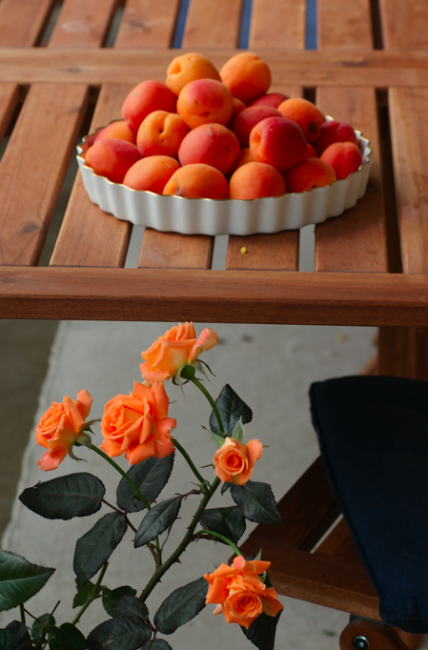
Mum came back with a load of fresh apricots from the market the other day. Apricots are big business in our valley - there are dozens of farms that line the bottom and sell their produce in little stalls by the road.  They're gorgeous. I love seeing all the fruit trees on the mountain side, sharing with the wine vines, heavy with bright fruit.

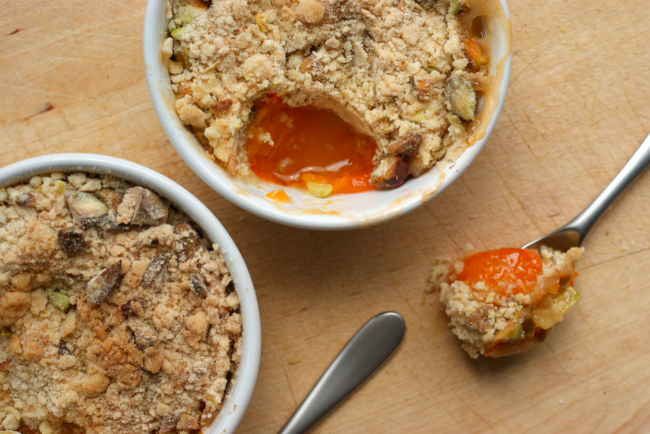
Apricot crumble seemed like a great way to use some of them up. The combination with pistachios is wonderful, so I incorporated them into the topping (which is divine in itself).


Of course you cannot have crumble without ice cream. I like vanilla with most of mine - this is a light 'Philidelphia' style ice cream that's perfect for summer. In the autumn I want to try cinnamon ice cream with apple crumble.

I discovered that a melon baller makes perfect little portions for individual ramekins - cute, eh.


I also make a bigger one each time (I've made this recipe twice in the past ten days... who is for lunch-pudding and supper-pudding?). Because I can't get enough. You could do the whole recipe in one bigger dish, too.

The apricots go gooey and sweet and keep their stunning colour. The pistachios meld beautifully with the flavour of the apricots and the ice cream is light, full of vanilla and just completes the picture.


Apricot and Pistachio Crumble
(heavily adapted from Delia's Complete Cookery)

10 apricots
75g plain flour
40g butter
40g brown sugar
40g pistachios
1/2 tsp baking powder
pinch of fleur de sel

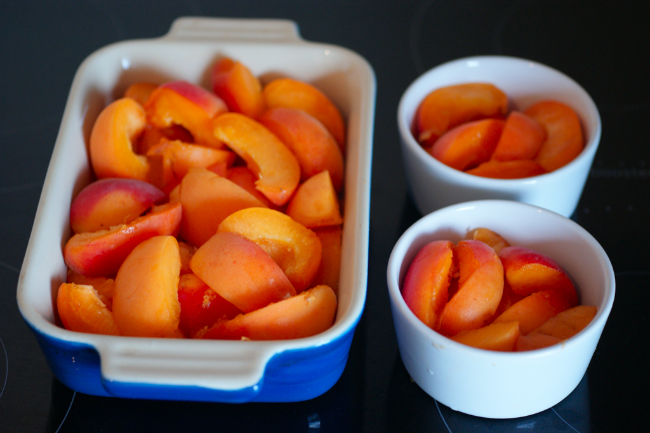
Preheat the oven to 180C/360F. Put the plain flour and baking powder into a bowl and mix them up. Add the butter and rub it in until it looks like crumbs. Stir in the brown sugar and salt. Roughly chop up the pistachios and stir them in too. Get your dishes together and slice up the apricots and arrange them in the dishes. Sprinkle a tablespoon or so of sugar over them, or more they're a bit sour. Spoon over the topping evenly. Put into the oven and bake for about 45 minutes or until golden brown and bubbling around the edges.

(Serves 6 - easily doubled)


Vanilla Ice Cream
(from Lebovitz's The Perfect Scoop)

500ml double cream
250ml whole milk
150g caster sugar
pinch of salt
1 vanilla pod
3/4 tsp vanilla extract

Pour half the cream and the milk into a saucepan with the sugar and salt. Scape the vanilla seeds from the pod and add them, along with the pod itself. Warm until the sugar has completely dissolved. Take off the heat and stir in the other half of the cream and the vanilla extract. Pour into a jug and chill throughly (overnight if possible). Just before churning, give it a good stir and remove the vanilla pod (you can rinse and dry it for another use, such as vanilla sugar). Freeze according to your maker instructions.

(Makes about 1 litre)

ShareThis